Can confirm: spoilers
Rogue One has much to recommend itself. The tremendous physicality of The Force Awakens is even more prominent In Gareth Edwards' film despite the absence of lightsaber duels; AT-ATs stomp with a colossal force, blaster shots strike hard, and Darth Vader's butchery of rebel soldiers at the film's conclusion feels visceral and really quite nasty. This is what was missing from Lucas's derided prequels-actions are rooted in the real world and therefore have real consequences. The physicality is complemented by the film's visuals; from the aerial sweep of the opening to the climactic crashing of two star destroyers, the photographic direction is superb, with an eye for the spectacular and the epic. Rogue One is unusual in today's cinematic field in that it demands to be viewed on the big screen, unashamed of its budget and its operatic silliness.
As the first of the planned "anthology" series (a new film released once every two years for the remainder of our lives), Rogue One makes effective decisions which differentiate it from the core films. Sweeping lightsabers and the force under the rug is refreshing, and confining these classic tropes to odd scraps of dialogue and occasional scenes suggests a much larger and more varied universe than the Jedi-centric world of the original movies. Avoiding the classic theme music as much as possible helps with this too, and the startling cut away from the familiar "a long time ago in a galaxy far, far away" title card tells us that we're in uncharted territory far more effectively than another yellow opening crawl. Rogue One is not Star Wars as we know it. It feels new.
That's not to say that the film's perfect. There's a pacing issue from the off, as the movie jumps from location to location too frenetically to be initially coherent. Some irritating clichés come up rather too often; there's an overuse of deus ex machina that J.J. Abrams largely avoided in The Force Awakens, with enemies taken down with shots from an off-screen blaster at a number of crucial moments. There are a few clunky death scenes too, with emotion noticeably forced through musical intensity. Although I've praised the film for largely avoiding the series' traditional musical motifs, the gimmick of allowing us to hear a few notes of a familiar tune before subverting them for a new theme quickly becomes annoying, and it's a shame that the film misses some opportunities to forge its own musical identity, instead settling to eschew that of its predecessors. And although the CGI Peter Cushing works pretty well as he's so often underlit and never looked entirely human anyway, the technology just isn't powerful enough to handle the softer contours of Princess Leia's face at the end of the film, which somewhat undermines an already rushed conclusion through uncanny-valley weirdness.
 There's a more general character issue too. Although Felicity Jones is excellent as Jyn Erso and brings some maturity to the role (she's far better than Daisy Ridley, who yelled and overacted her way through the otherwise spot-on The Force Awakens), the supporting cast is problematic. Jyn notwithstanding, The Rogue One team is essentially a series of ciphers; the almost-Jedi ninja, the gun crazy one etc. They're the type of lazy archetypes you'd expect from a Michael Bay film, but the real issue is their interaction; while Rey, Finn, Poe and BB-8 immediately established a group dynamic in The Force Awakens, this doesn't really happen in Rogue One. We're unsure about the relationships between the characters, and their actions therefore lack motivation and become confusing. They're not compelling, and attempts at poignancy fall somewhat flat as a result.
The film gets around its character problem in a rather innovative way: it kills them all. The shock of seeing every major character on our side die forces us to forget their developmental issues; it's a cynical and extremely bleak technique. The film's darkness is emphasised by the visuals and the physicality I mentioned earlier; there's still no blood, but Vader's lightsaber-wielding slaughter of rebels is genuinely distressing. At one point, a key character is killed by a grenade thrown by a random Stormtrooper. There's a moment before the grenade explodes in which we realise that the death is inevitable. Then it happens, and he is not mentioned again. George Lucas would never have signed off on that.
Vox was recently mocked for an absurd headline suggesting that Rogue One is the first Star Wars film to acknowledge that the franchise is about war, but the review's point is clear and legitimate. Death feels closer and more real in Rogue One than at any other point in the series, and is emphasised by the more limited humour, with only the great new droid (who also dies) providing comic relief.
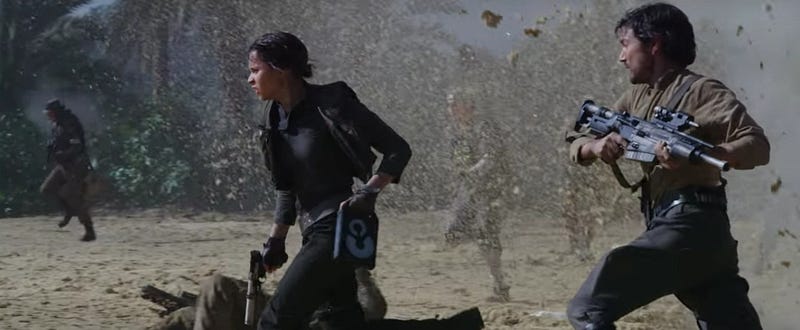
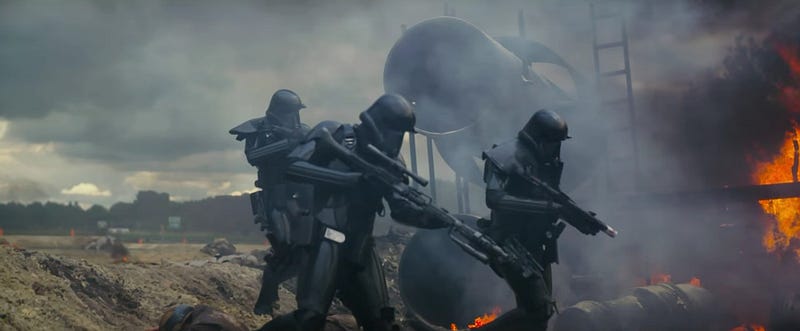 This is coupled with an ideological shift away from the unabashed idealism of the core films. No longer is good good and evil evil; the Rebels are overtly exposed as an extremist group which authorises heinous and unnecessary murders. The troops at the bottom refuse to challenge even the most aggressive orders from command; as Jyn points out, there is little difference between them and the Stormtroopers, particularly given their underdeveloped characters. The original Star Wars was a deliberate response to the nihilism of post-Vietnam filmmaking in America, as Lucas provided a refreshingly positive counterpoint to contemporaries such as Friedkin and Scorsese, whose dark films and painful endings reflected American dread following the Tet Offensive. Lucas's film was idealistic and naive, and proud to be so. The Force Awakens was a continuation of this, but Rogue One has almost more in common with troubled early 70s filmmaking than the it does with first Star Wars movie. The film seeks to reflect its time rather than act against it, and does so both directly through the ISIS-emulating Rebels, and indirectly through the general sense of bleakness which pervades the film as a reaction to the troubled 2016. Time and time again, explosions look like mushroom clouds.
Rogue One has compromised the idealism which motivated the first Star Wars. The director has deliberately exposed the logical flaws and inconsistencies which underpin the whole premise of the drama, issues we've always known about but have never brought up for fear of ruining the magic. Abrams knew about them, but his film ignored the problems. Perhaps in a year defined by terrorism and anti-establishment populism, Hollywood can no longer justify glorifying rebellions and refusing to examine their flaws. Perhaps this was inevitable. Regardless, the film has pulled the rug out from underneath the purity of the Star Wars concept; it is not escapist in the way that The Force Awakens was and cannot be reconciled with the idealism of Lucas's dream. It is great movie set in the Star Wars universe, but it is not a Star Wars film.