Saturday, 10 March 2018

Why I didn't get Call Me By Your Name, and why I can't explain why I didn't get Call Me By Your Name

I think—and I really want to stress that, because it’s the only reason I can think of that I didn’t fully connect with Call Me By Your Name—that the film doesn’t want to be connected with. I should have got it, because in talking about the film with friends I’ve had to praise every one of its constituent parts. It has the best male performance of last year in Timothée Chalamet’s Elio, who holds the screen in a tearful close-up for the full last four minutes. With the shot’s tiny depth of field, people move about the background while Chalamet is seen only by us, the camera noticing every emotional shift that twitches from his eyes and lips. This is cinema acting, utterly distinct from the Victorian melodrama The Academy handed Chalamet’s Oscar to, and it’s devastating. But it’s funny too—after all, this is a movie about a summer’s fling.

It’s a long film full of long takes; shots of doors, shots of sunlight refracting in a pool of cold water, shots of faces. For many of these shots, the camera remains still for second after second, and the film occasionally takes on the hazy look of a set of holiday slides. But it’s long. So long, in fact, that we find ourselves distanced from the momentum of the romance. When action comes, it comes suddenly. This can be exciting—Elio using a peach to masturbate is the sexiest moment I can remember from a recent movie, because when Elio struggles to bite out the stone, dripping juices all over his bed, it’s naturalistic and completely believable. Chalamet had to be convinced to do the scene, and the reason for that goes deeper than any fruit-based fetishism—think of the fun he must have had with his embarrassing sex in the wonderful Lady Bird. In Lady Bird, Chalamet is an archetype, and his uninterested approach to female pleasure is just what we expect from him. But masturbating with a peach is unexpected, because it’s preceded by a bunch of long takes of doors.

I’m being flippant, but I’m trying to get to the root of why I struggled with Call Me By Your Name. For all I loved the sharp transitions to sexiness, the romance between Elio and Oliver simply does not make sense. We aren’t shown enough—not enough of them together, not enough flirting—and the advances in their relationship are jarring, almost frightening. I wasn’t put off by the treatment of the age difference at the time, but since much of the film is given to us from Elio’s perspective, unexpected sex brings with it a suggestion of the threatening power of the older, more experienced man taking more control than the film wants to admit. Unexpected sex leaves us to fill in explanatory gaps, things which we aren’t told, and Oliver’s presence (or nonpresence) makes that uncomfortable. In colour in pacing, the movie is dreamlike, and like a dream it hints towards worries at the back of the mind. Old archetypes; the young learn from the old, the old enjoy the young.

The father’s monologue towards the end of the movie compounded my anxieties. He tells Elio to learn from his experience, tells him not to be victimised. He tells him that something similar happened to him. To treat this scene as life advice, as objective truth that shouldn’t be worried about, would be like reading Tennyson’s ‘Ulysses’ as a rallying cry for us all to take ship and seek a newer world. This is a film about nostalgia, seeped through with dancefloor colours and new wave tunes that bleed into one another like paints on a canvas. When characters talk nostalgically, as the father does here, we should think about what they’re saying. By telling Elio that he’s in control, that he can make what he will of what he had with Oliver, his father lies to him and perpetuates a cycle. Throughout the film, we are shown that Elio doesn’t control anything. That’s not just about sex, although Oliver excruciatingly teases him with the peach and with an unfinished blowjob. It’s about pacing, and things happening without warning as if we know where the story’s going to go as soon as it begins, as if the filmmakers just have to fill in the details and let us work out the rest. About the audience knowing what a relationship between an older man and a younger man is about without having to see the movie. It’s not Oliver’s fault, and the film doesn’t blame him. It’s just the way it is.


Monday, 11 September 2017

Summer reading

Handed a spiralling reading list to celebrate finishing my first year at university-a list that I'd count a pretty heavy text in itself-I've avoided most of it like the black death. Here, in no particular order, is what I read this summer.
Tess of the d'Urbervilles by Thomas Hardy took me a while. Maybe it was getting back into the routine of reading after some time apart, or maybe it was just how boring I found most of it. It's written gorgeously, and every few sentences something poetic really sticks out at you-the miasma of drunken conversation. But it didn't make up for how much I hated every single character. There are some very impactful moments-a woman's desperate prayers as her rape-child dies in her arms, the timid Tess magnified to some witchy, elemental power. Alec, her 'reformed' rapist, demanding that she marry him to remain "morally right and proper". Things like that, made shocking by either dismantling Victorian ideals of exemplifying them to such a harrowing degree that we are reminded of how dire they really were. But God, it was boring. I cheered the murder.
But boring doesn't come close to Ulysses by James Joyce. I got through about 400 pages, decided I was wasting my time and stopped. I got little enough out of Tess, but this was a joke by comparison. I enjoyed, occasionally, some of the linguistic detective work I had to do to figure out what was going on, linking the prose back to odd words mentioned pages earlier. There were a few things that struck me as poetry too-the flower of the masturbatory bath. But I just got tired. I'm not ready for this, but I felt a bit better than that when Bob Dylan mentioned in his book Chronicles Vol. 1 that he couldn't make head or tail of the thing either. Dylan's book is wonderful-probably the best autobiography I've ever read. That's because Dylan doesn't write it like one-it opens in media res, in a freezing New York winter, and follows a few distinct, non-chronological periods in Dylan's career rather than aiming for something comprehensive. The writing is inflected with lyrics and beat poetry-like the stuff he puts on the backs of his albums-and there's a lot of interesting stuff about his reading and influences, like his sublime Nobel Prize lecture where he talks about Moby Dick (which I've not yet finished), All Quiet on the Western Front and the Oddesy. There are great music recommendations too-it's really bizarre today to think of Dylan hitching rides across the state to hear rare folk records at friends' houses-just a completely different weight placed on listening. Certain sections are more interesting than others, and I found some of the bits on recording and music theory a little dull, especially since I didn't know the songs. But overall it's excellent, and the final pages-leaving the superficial paradise of folk music for the world owned by neither God nor the devil where bras and bibles work alike-is powerful beauty.
To go with Joyce, I read quite a bit by the other big modernist T.S.Eliot-essays, poems, a play. I read The Waste Land again and some criticism, and I still love it, and trying to work out the allusion and just what's going on-think I missed the seduction of the secretary first time around. It's more manageable detective work than Joyce. I guess Eliot and Joyce were doing a similar thing in resisting the conformity they saw in modern life through radical creation, but Eliot just seems so much better. I liked Murder in the Cathedral too, even if verse drama is pretty unfashionable. It has that idea of fear of change you see in The Waste Land, and a really funny moment where the killers break out of the verse and explain, in dull, precise prose, just why they did it. For pages. His essays, however, I can't stand. His fascistic, misanthropic self comes out in the way he talks about the general reader, and his objective correlative take on Hamlet is just garbage. I also read a few Cantos by his contemporary Ezra Pound, and I thought their movement, rhythm, and how the sound works it way around all the complex allusion and classic stuff was just brilliant. Must read a bit more, but the book is fucking big.
 I read a few more recent novels too, mostly recommended by the English faculty. I saw a friend in Don Dellio's trippy The Day Room in Cambridge and very much enjoyed it, as I did his book White Noise. It's very quippy-nearly every sentence has something clever or funny about it, and the dialogue has that Lynchian ability to zoom into flowery hyperrhetoric at a moment's notice. There are a bunch of great ideas going on-Hitler studies, the Toxic Airborne Event, although the violent ending with the gun feels very forced. Even better was Remainder by Tom McCarthy-addictive reading, and a great study of Melvillian monomania that spirals into a violent ending which is satisfying and actually makes sense. It's a really good premise-just a guy trying to recreate something, with total particularity. Less interesting was The Crying of Lot 49 by Thomas Pynchon. Like White Noise, it's idiosyncratically written with lots of long, listing sentences, but the whole thing is so (deliberately) convoluted and hard to follow that I soon got sick of it. The best part was a little like the best part of Murder in the Cathedral-a load of pages devoted to a description of the plot of The Courier's Tragedy-a spoof Renaissance drama in the style of The Revenger's Tragedy and The Spanish Tragedy that effectively picks out the excesses of the genre-it's all incest, backstabbing, people getting shot out of cannons in a mess of flying bloody pulp. I liked Fear and Loathing in Las Vegas rather more fully, really burned through it. It's just the right length so that all its ridiculous excesses of sex and drugs don't get dull (as they do in Money), and the illustrations do a great job of matching it. It's funny, destructive writing.
I got a lot of inspiration to write a teen novel from The Rachel Papers by Martin Amis. God, I loved this book, but it's a serious guilty pleasure, because you can see how blatantly steals from The Catcher in the Rye, and how much it influenced John Green (incidentally, I did the best never have I ever yesterday-never have I ever cried over a John Green novel). All the fun here is in the narrator Charles Highway, a brilliant, big-cocked name as he notes on the first page. He's truly awful, in a delightfully awful way. Chummy with Blake, and not just because of all the fucks he got me. Taking Rachel to see a French film, to let her know how good I was going to turn out in bed. Obsessed, with literary pretension, means of seduction, narcissism. Lists of the top ten anxieties of the week, like the charts. He's terrible. It's a terrible delight, from start to finish. I'm glad I didn't read it a few years ago, because I think it would have made me much, much worse than I was with just Plath and Salinger (and all the literary stuff would have gone right over my head).
I read The Communist Manifesto, this time with an AJP Taylor introduction, and wow has my opinion changed. Communism is an idea I could start to get behind, but Marx himself went down so much in my estimation reading this now. Holy shit. He just lies. The big one-history is the history of class conflict-is just a big, empty generalisation. Uniformed, GCSE stuff. For most of history, the working classes have been pretty happy to be subservient if it ensures survival. Even the French revolution was a product of rich men. There a other big generalisations, like his ignoring conflict within classes, and his whole philosophy seems to move towards a proletariat utopia, history moving towards an endpoint, wrongheaded thinking like Hegel. And he's just plain wrong about a lot of stuff-capitalism peaking in 1847, the Manchester cotton workers being the hungry proles, assuming that industry could represent all industry, the working class getting poorer as capitalism develops, value being determined by the socially necessary labour. Marx was a propagandist y'know. Sure it's an influential book (the last religion?), but a lot of the work was already there I think-Babeuf etc. I also read some great introductory philosophy books by Paul Stathern-Plato, Aristotle, Locke, Nietzsche-just the useful stuff.
I'm trying to get a more solid understanding of art-I've just started The Story of it. Because it looked so beautiful, I read Ways of Seeing by John Berger, which is a great set of essays. I was reminded of how it's impossible not to take Shakespeare out of context with the stuff about the art world curling back into issues of value and rarity as the real world becomes more democratised. The essay on the presentation of women was predictable and dated in parts, but interesting in the specific discussions of paintings, and the one on advertising and the invention of glamour is excellent. Ads steal your self worth, man. And then they charge you for it back.
I've just started Stephen King's It after seeing the film (which, I'll just say, I loved), and earlier in the summer I read Different Seasons, a collection of four novellas and my 10th King book, after just about enjoying Stand by Me (I've still not seen The Shawshank Redemption though). Shawshank is great fun-simple, but a blast. The Body also terrific. Apt Pupil is the best in the set, probably the most horrific thing I've read by him. The Breathing Method is really two ideas, and a little more unhinged, but still gripping and packs a real shocker towards the end. Superb set, with some of the man's best character work. I also cut through The Stepford Wives by Ira Levin, King's favourite suspense writer. I would have liked a bit more on the whole robot thing, but the ending is quietly unpleasant, and male resistance seems quite an interesting issue in second wave feminism that I've not really thought about before. Levin, on the basis of this and Rosemary's Baby, seems a deeply feminist writer.

And I'm still reading Moby Dick, Dombey and Son and Middlemarch, but I'm not there yet. 


Friday, 23 December 2016

Rogue One: Compromised idealism

Can confirm: spoilers

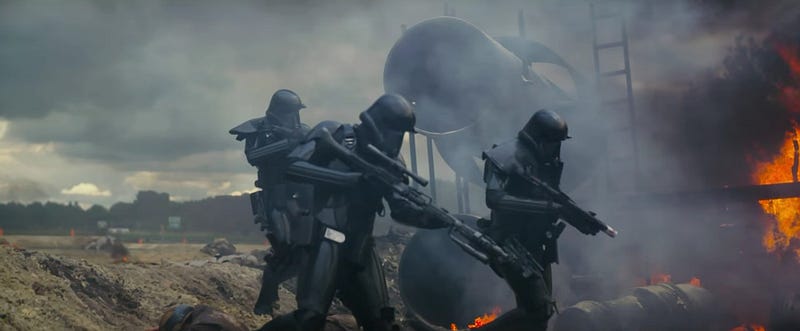
Rogue One has much to recommend itself. The tremendous physicality of The Force Awakens is even more prominent In Gareth Edwards' film despite the absence of lightsaber duels; AT-ATs stomp with a colossal force, blaster shots strike hard, and Darth Vader's butchery of rebel soldiers at the film's conclusion feels visceral and really quite nasty. This is what was missing from Lucas's derided prequels-actions are rooted in the real world and therefore have real consequences. The physicality is complemented by the film's visuals; from the aerial sweep of the opening to the climactic crashing of two star destroyers, the photographic direction is superb, with an eye for the spectacular and the epic. Rogue One is unusual in today's cinematic field in that it demands to be viewed on the big screen, unashamed of its budget and its operatic silliness.

As the first of the planned "anthology" series (a new film released once every two years for the remainder of our lives), Rogue One makes effective decisions which differentiate it from the core films. Sweeping lightsabers and the force under the rug is refreshing, and confining these classic tropes to odd scraps of dialogue and occasional scenes suggests a much larger and more varied universe than the Jedi-centric world of the original movies. Avoiding the classic theme music as much as possible helps with this too, and the startling cut away from the familiar "a long time ago in a galaxy far, far away" title card tells us that we're in uncharted territory far more effectively than another yellow opening crawl. Rogue One is not Star Wars as we know it. It feels new.  

That's not to say that the film's perfect. There's a pacing issue from the off, as the movie jumps from location to location too frenetically to be initially coherent. Some irritating clichés come up rather too often; there's an overuse of deus ex machina that J.J. Abrams largely avoided in The Force Awakens, with enemies taken down with shots from an off-screen blaster at a number of crucial moments. There are a few clunky death scenes too, with emotion noticeably forced through musical intensity. Although I've praised the film for largely avoiding the series' traditional musical motifs, the gimmick of allowing us to hear a few notes of a familiar tune before subverting them for a new theme quickly becomes annoying, and it's a shame that the film misses some opportunities to forge its own musical identity, instead settling to eschew that of its predecessors. And although the CGI Peter Cushing works pretty well as he's so often underlit and never looked entirely human anyway, the technology just isn't powerful enough to handle the softer contours of Princess Leia's face at the end of the film, which somewhat undermines an already rushed conclusion through uncanny-valley weirdness. 

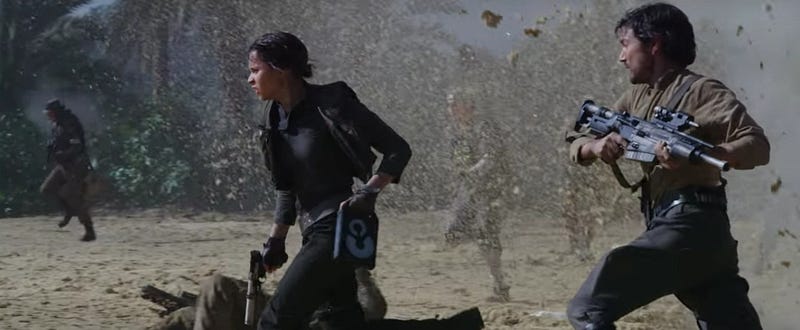
Image result for rogue oneThere's a more general character issue too. Although Felicity Jones is excellent as Jyn Erso and brings some maturity to the role (she's far better than Daisy Ridley, who yelled and overacted her way through the otherwise spot-on The Force Awakens), the supporting cast is problematic. Jyn notwithstanding, The Rogue One team is essentially a series of ciphers; the almost-Jedi ninja, the gun crazy one etc. They're the type of lazy archetypes you'd expect from a Michael Bay film, but the real issue is their interaction; while Rey, Finn, Poe and BB-8 immediately established a group dynamic in The Force Awakens, this doesn't really happen in Rogue One. We're unsure about the relationships between the characters, and their actions therefore lack motivation and become confusing. They're not compelling, and attempts at poignancy fall somewhat flat as a result.

The film gets around its character problem in a rather innovative way: it kills them all. The shock of seeing every major character on our side die forces us to forget their developmental issues; it's a cynical and extremely bleak technique. The film's darkness is emphasised by the visuals and the physicality I mentioned earlier; there's still no blood, but Vader's lightsaber-wielding slaughter of rebels is genuinely distressing. At one point, a key character is killed by a grenade thrown by a random Stormtrooper. There's a moment before the grenade explodes in which we realise that the death is inevitable. Then it happens, and he is not mentioned again. George Lucas would never have signed off on that.

Vox was recently mocked for an absurd headline suggesting that Rogue One is the first Star Wars film to acknowledge that the franchise is about war, but the review's point is clear and legitimate. Death feels closer and more real in Rogue One than at any other point in the series, and is emphasised by the more limited humour, with only the great new droid (who also dies) providing comic relief.

This is coupled with an ideological shift away from the unabashed idealism of the core films. No longer is good good and evil evil; the Rebels are overtly exposed as an extremist group which authorises heinous and unnecessary murders. The troops at the bottom refuse to challenge even the most aggressive orders from command; as Jyn points out, there is little difference between them and the Stormtroopers, particularly given their underdeveloped characters. The original Star Wars was a deliberate response to the nihilism of post-Vietnam filmmaking in America, as Lucas provided a refreshingly positive counterpoint to contemporaries such as Friedkin and Scorsese, whose dark films and painful endings reflected American dread following the Tet Offensive. Lucas's film was idealistic and naive, and proud to be so. The Force Awakens was a continuation of this, but Rogue One has almost more in common with troubled early 70s filmmaking than the it does with first Star Wars movieThe film seeks to reflect its time rather than act against it, and does so both directly through the ISIS-emulating Rebels, and indirectly through the general sense of bleakness which pervades the film as a reaction to the troubled 2016. Time and time again, explosions look like mushroom clouds.

Rogue One has compromised the idealism which motivated the first Star Wars. The director has deliberately exposed the logical flaws and inconsistencies which underpin the whole premise of the drama, issues we've always known about but have never brought up for fear of ruining the magic. Abrams knew about them, but his film ignored the problems.  Perhaps in a year defined by terrorism and anti-establishment populism, Hollywood can no longer justify glorifying rebellions and refusing to examine their flaws. Perhaps this was inevitable. Regardless, the film has pulled the rug out from underneath the purity of the Star Wars concept; it is not escapist in the way that The Force Awakens was and cannot be reconciled with the idealism of Lucas's dream. It is great movie set in the Star Wars universe, but it is not a Star Wars film.

Pauline Kael would have loved it.

Monday, 11 January 2016

I heard the news today, oh boy

It says something about the artist David Bowie was that nearly everyone who loves him remembers the first time they heard him sing. For me it was at primary school, when I was about 8 years old. Our music teacher dragged the ancient classroom CD player from its lonely cupboard and explained that the time had come for us to hear some real music. Perhaps I exaggerate. Our music teacher was one of those people who really should have gone on to become one of the defining artists of their generation, a dark haired drummer who wore denim jackets to school and every other lesson gave us a blow-by-blow account of how, way back in the day, his band had played on the hallowed turf of the Glastonbury festival. Aside from relaying this frankly dubious anecdote, his lessons largely consisted of giving our class an education in the music of his youth, for he was never particularly  interested in teaching us the basics of the recorder and triangle that the curriculum demanded (the Jack Black in School of Rock impression is completed by his overseeing the management of my first band's only concert, in which I played a "keyboard solo" of a C major scale).  I am grateful to him now.

So there we were: thirty kids eager to discover what cultural nugget had been prepared for us today. The music teacher smiled knowingly as he slipped the CD into the archaic machine. He pressed play. The song was Space Oddity. 
When it was over, someone asked him, reverently, if he might play it again. This pleased our music teacher. It pleased me too.

Fast forward to November 2015, as the final, demented notes of Bowie's latest single, Blackstar, draw to a close. It is my first listen. Throughout this ten minute odyssey, I've been struck by just how much listening to Blackstar has reminded me of hearing Space Oddity all those years ago. It's not that the songs sound the same; the storytelling that I loved so much on Space Oddity-who could forget the sheer horror of the moment Major Tom's circuit goes dead-has been replaced by cryptic, image-heavy lyrics and jazz-influenced instrumentation. Instead, what I'm reminded of is how different Space Oddity sounded from everything I'd ever heard before. Because David Bowie's music still sounds like nothing else in the world.

That was what had amazed me most, staring in shock at the old CD player perched neatly on a stool. Nearly forty years after its release, Space Oddity really did sound like something completely new. I was transfixed. I think my parents were pleased when I came home talking about David Bowie; my music taste at the time, which largely consisted of Basshunter's 2006 classic Now You're Gone and one Muse song I'd heard in the background of Doctor Who Confidential, had not been kind to their hearing. And so it was that I became Bowie mad, first through constant exposure to his Best Of album on family drives through Cornwall, then by watching, reading and listening to everything I could find concerning the Thin White Duke, Aladdin Sane and Ziggy Stardust. Although Bowie wouldn't release new music for six or seven years after I first heard his voice and although I turned up a couple of generations after his original fanbase did, I was in love. And there was so much to love: the style, the decades-old gossip (did Bowie sleep with Mick Jagger? His wife seemed to think so), the delicious humour (the 1964 interview regarding 17-year-old Bowie's formation of the Society for the Prevention of Cruelty to Long Haired Men remains, as it was then, hilarious), and the songs. And what songs they were. The ethereal Life on Mars, the swagger of Rebel Rebel and Young Americans, the careful, subtle Wild is the Wind. The Man Who Sold the World. Oh! You Pretty Things. Starman. Five Years. The rampant, dance floor assault of Suffragette City. The black-hearted Space Oddity sequel Ashes to Ashes. The sheer catchiness of Sound and Vision and Let's Dance. Sorrow, Rock 'n' Roll Suicide, Drive-In Saturday, Ziggy Stardust, Fame, Heroes, and the catwalk-strutting Diamond Dogs. And, later, The Stars (Are Out Tonight), Where Are We Now and Blackstar. And oh, so many more. Bowie had a near-unique combination of talents for songwriting and experimentation that allowed him to stretch the boundaries of his sound while still crafting completely perfect songs.

Fast forward two months. David Bowie is dead. I heard the news today, oh boy.

There was a moment of shock when I saw the announcement this morning, which fell away after some comforting reports claiming the announcement to be a cruel hoax. But then death was everywhere, and it was true. When Changes, that most truly perfect track, came on the radio, the sadness was harsh and biting. His was the first music that I had ever loved. 

But I put Young Americans on and went to school. And as the saxophone swung into life and Bowie began to sing, I began to not feel sad. I felt happy. Happy that a person like Bowie-no, not a person like Bowie, Bowie himself, could have and did exist, and gave so much to the world. His influence is hard to overstate. I have complete faith-in fact I know-that in ten, fifty, a hundred years time, people will hear Space Oddity for the first time and start bands, write books, create.  This is what he leaves behind. As has been pointed out, the earth is 4.543 billion years old, and we all existed at the same time as David Bowie. I, for one, am glad.